Websites for clinics and doctors
A patient usually finds a clinic through a single search and decides on the first page. We build calm, fast pages that give accurate information — for dental clinics, doctors, psychologists, dietitians and physiotherapists — with the rules on health advertising in mind from the very start.
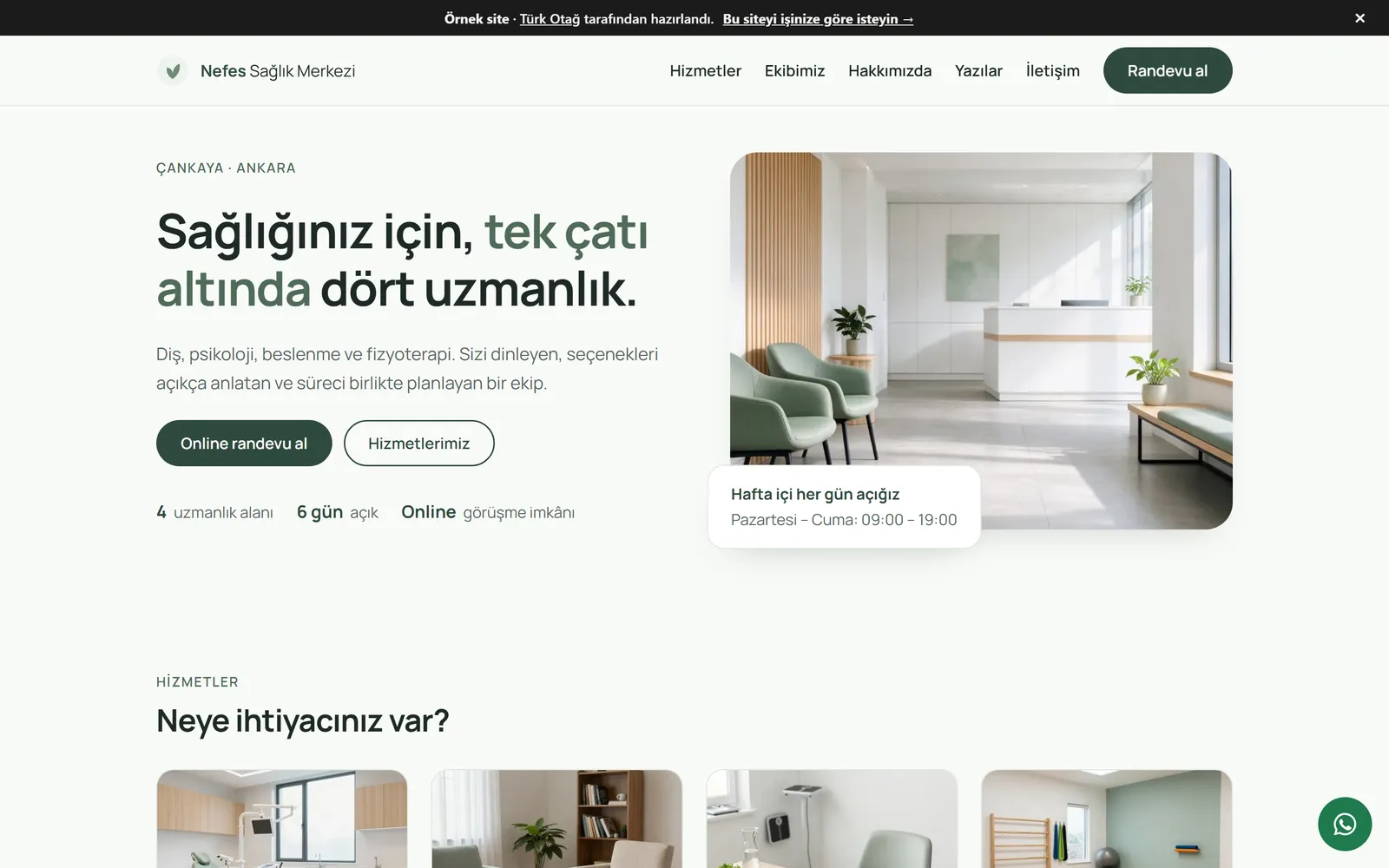
A website for a doctor or a clinic has three jobs to do at once: make the treatment or specialist a patient is looking for easy to find in search, earn trust at first glance, and shorten the path to an appointment. There is a limit to work within, too. In Türkiye, the promotion of health services is governed by regulation — patient reviews, price announcements and claims of superiority have no place on these sites. When we build a website for a dental clinic, a doctor, a psychologist, a dietitian or a physiotherapist, we think about both sides together. Below, we explain what we do and why. There is also an example you can click through: the Nefes Health Centre demo site, a live site we built for a fictional multi-disciplinary centre. Like all our demo sites, it is in Turkish — the structure is what to look at.
The pages a clinic website needs
A clinic site need not be crowded. But every page should have a job. The patient’s question is clear enough: “Does this clinic deal with my problem, who will see me, where is it, and how do I book?” The page structure follows the order of those questions.
| Page | What it does | On the demo site |
|---|---|---|
| Home | Says at a glance which fields the clinic works in, and points towards booking | Home |
| Services | Lists every department; each opens onto its own page | Services |
| Service detail | The scope, process and common questions for a single treatment or department | Oral and dental health |
| Team | Each clinician’s title, field of work and a short introduction | Our team |
| About | The clinic’s approach and way of working | About |
| Online booking | A request sent by choosing a department, date and time | Online booking |
| FAQ | Booking, cancellations, the first appointment, getting there | FAQ |
| Articles | Informational content on keeping well | Articles |
| Gallery | The place itself: waiting room, treatment rooms | Gallery |
| Contact | Address, map, telephone, opening hours | Contact |
Two things missing from this list are deliberate. There is no “patient reviews” page. Nor is there a “special offers” page. We explain why below, in the section on regulation.
Beneath every page there is also a layer you cannot see but which matters: structured data. We mark up the clinic’s name, address, opening hours and departments in a form search engines can read. This helps the right details appear when someone searches for the clinic by name.
Treatment and service pages: one each, found when searched for
People do not only search for “dental clinic”. They search for “how long does root canal treatment take”, “when should my child first see a dentist”, “how does online therapy work”. Each question expects a different page. List every service on a single page and you will not appear strongly for any of those searches.
So we build a separate page for each department or treatment. The oral and dental health page on the demo site is one example. The page runs in this order:
- A short introduction: who the department is for, in two or three sentences.
- Scope: sub-headings such as examination, cleaning and fillings, each in a sentence.
- Process: the steps from the first consultation to the follow-up appointment.
- Questions for that department: two or three questions people genuinely ask about that treatment.
- Booking link: opens the booking form with that department already selected.
The language stays plain and measured. We steer clear of promises such as “painless”, “permanent” or “the latest technology”. The regulation asks for this, and patients notice exaggeration anyway. We write the copy together: the clinician approves the medical accuracy, whilst we take care of readability and search intent.
Alongside the service pages there is one more small but effective content area: articles. Short pieces on keeping well — “how often should teeth be scaled?” — answer the patient’s question and help the site appear for more searches. We look at this in more detail in our article on websites for psychologists and doctors.
Content within health advertising rules: reviews, before-and-after images, prices
In Türkiye, the promotion of health services is governed by the Ministry of Health’s Regulation on Promotional and Informational Activities in Health Services (Official Gazette, 12 November 2025, issue 33075). It covers health professionals, private health facilities and health tourism intermediaries. Websites and social media are explicitly within its scope.
The core principle is this: open or covert advertising of health services is prohibited, but promotion and information that follow certain principles are permitted. Address, contact details, opening hours, fields of specialism, the qualifications of the professionals and information on keeping well are treated as the natural content of promotion. The points from Articles 5 and 7 that matter most for a website can be summarised as follows:
| Subject | The regulation’s approach | How we handle it on the site |
|---|---|---|
| Patient thanks and satisfaction reviews | May not be used for promotional sharing | We do not build a reviews, testimonials or ratings section |
| Prices, discounts, campaigns, promotions | May not appear in promotion or information | No price list, discounts or campaign area |
| Implied superiority | No promotion that suggests a service is superior to others or exploits a lack of knowledge | No wording that claims superiority or promises a certain result |
| Unproven methods | No statements about methods not scientifically and clinically proven | Service copy is published with the clinician’s approval |
| Company, product or brand promotion | No covert or open brand promotion, and no links given for that purpose | We do not link to equipment or product brands |
| Before-and-after images | Permitted subject to explicit consent, the same setting and technical conditions, dates, nothing misleading and a mandatory notice | If the conditions cannot be met, we recommend not using them |
| Moments of surgery or intervention | Images of the patient during these may not be shared | The gallery shows the place, not the patient |
| Updates and editor details | The date of the last update and the editor’s contact details must be stated clearly | Pages carry an update date and the responsible person’s contact details |
One more note: the regulation does not allow content that steers a patient, directly or indirectly, towards a particular clinician or facility. So we keep calls to book calm. Instead of pressure — “call now, before the slots run out” — we write “leave a booking request and we will call you”.
This table is a summary. The full regulation and its annexes go into more detail, particularly on images and sanctions. We prepare the site with the regulation in mind; the final check of the content rests with you and your legal adviser. This page is not legal advice — please confirm the current text with your professional body or legal adviser. If your practice is outside Türkiye, your own regulator’s rules apply, and we work to those instead.
Online booking and WhatsApp: forms that respect data protection
The booking form is the most-used page on a clinic site. It is also the page that collects the most sensitive data. So we balance two things: the patient should be able to complete the form in a minute, and the form should not ask for more data than it needs.
The online booking page on the demo site has three steps:
- Department: dentistry, psychology, nutrition or physiotherapy. Arriving from a service page opens it with that department selected.
- Date and time: a day from the calendar, a time from the buttons. An “online session” option for psychology and nutrition.
- Contact: name, telephone and an optional short note. A link to the privacy notice and a consent box.
The field for describing the complaint is deliberately optional. Health data is a special category of personal data — under KVKK, Türkiye’s data protection law, as under GDPR — and if a field does not need to be mandatory, we do not make it so. Every field on the form can be completed with a keyboard, and its labels are read correctly by screen readers.
On a real site, requests go to the address or booking software the clinic chooses. We can also add a fixed WhatsApp button, so the patient can message the clinic’s line with a single tap. (On the demo site the forms and this button send nothing.) We describe how to set up the booking flow in our article on online booking systems.
Dental clinics, psychologists, dietitians and physiotherapists: needs that differ
The same regulation, the same basic structure. But each discipline’s patients expect something different from the site.
Websites for dental clinics
A dental clinic’s list of services is long: examinations, cleaning, fillings, root canal treatment, children’s dentistry, dentures, implants. Each one is a separate search. The real work here is to build the page structure well and explain each treatment clearly. Requests for before-and-after images come most often from this discipline; we weigh the conditions above together with you.
Websites for psychologists
Someone looking for a psychologist often searches at night, on their phone, quietly. The site should not use the language of sales; it should be calm. Areas of specialism — anxiety, panic, depression — each have their own page. How online sessions work, how confidentiality is protected, what happens in the first session: all of this is written out plainly.
Websites for dietitians and physiotherapists
On dietitians’ sites, “how much weight our clients lost” easily turns into a promise of results; instead, we describe the approach and the follow-up process. In physiotherapy, patients search by complaint — “lower back pain”, “sports injury” — so the pages are built around complaints. As the regulation covers health professionals, following the same principles in these disciplines is the safe course.
For centres that bring several disciplines under one roof, the structure of the demo site is a good starting point: psychological counselling, nutrition and diet and physiotherapy share one template, yet each speaks to its own questions.
Does medical tourism need a separate site?
The Turkish regulation has a separate section for clinics that accept patients from abroad. Promotion aimed at patients abroad is expected to run through a separate website or platform. It is also subject to extra conditions, such as holding an international health tourism authorisation certificate and publishing it on the site. The rules for a site aimed at people in Türkiye and those for a health tourism site aimed abroad are therefore not the same.
In practice, this means adding an English tab to your existing Turkish site may not be enough. If you hold the certificate, we can build two separate sites on a shared design system. They look like part of the same family, but their content and rules are managed separately. We recommend settling the question of authorisation and scope with your legal adviser before we build.
A real example: Gülşah Yalçın
The demo sites are for fictional businesses. We can show a real health site as well: the website we built for Gülşah Yalçın, a psychologist who offers online therapy.
The site has 85 pages: 13 pages on areas of specialism, 32 articles, a psychology glossary of 19 entries and 4 self-assessment questionnaires. Each area of specialism sits on its own page, with its own search intent. The articles, glossary and FAQs link back to those pages, so a reader moves from one question to the next without getting lost. In Lighthouse, its accessibility and SEO scores are 100.
We did not use the language of sales on this project. There is no reviews section and no promise of results. The content itself builds the trust. We describe how the project came together in the Gülşah Yalçın case study.
How we work
We do not use off-the-shelf themes. For each clinic we build a design system: colour, type, spacing and components. The pages are static and light; on our demo sites, mobile Lighthouse performance sits between 96 and 100, accessibility is 100 and layout shift (CLS) stays below 0.05. For accessibility, our target is WCAG 2.2 AA. That means older patients, people with low vision and those who use screen readers can all use the site with ease.
In short, the process runs like this:
- Discovery: we listen to how your disciplines, patients and booking process work. Meetings can be remote or in person; we work with clients wherever they are.
- Page structure and content: which page for which treatment, which answer for which question. You approve the medical copy.
- Design and development: one page first, then — with your approval — the whole site.
- Launch: domain, structured data, search engine registration and analytics.
- Afterwards: monthly maintenance if you would like it; the source code can be handed over to you if you wish.
We describe our general approach to web design on the web design service page. For another profession where similar rules apply, see the page on websites for law firms; for accessibility, see accessible websites.
Let us work out together which pages your clinic needs. Get in touch with a few lines about your practice — we reply within two working days.
Explore the example site
- Online booking A step-by-step booking request — department, date and time — with a data-protection consent box.
- Services Dentistry, psychology, nutrition and physiotherapy, each opening onto its own page.
- A service page Scope, the steps of a visit and questions specific to that department, all on one page.
- The team Each clinician's title, field of work and a short introduction — no claims of superiority.
- Frequently asked questions Practical answers on booking, the first appointment, cancellations and getting there.
- Articles Short, clear articles on keeping well.
- Gallery The waiting room and treatment rooms — the place is shown, never a patient.
Work we have done in this field.

Frequently asked questions
Can we publish patient reviews or thank-you messages on the site?
In Türkiye, the regulation on health advertising states that patients' or relatives' thanks and expressions of satisfaction may not be used for promotional sharing in any medium, websites included. So we do not build a reviews or testimonials section. Trust comes from information about the team, a clear account of each service and accurate contact details. If you practise elsewhere, the rules will differ — we work to whatever your regulator requires.
Can we show before-and-after photographs?
The Turkish regulation does not ban them outright, but it sets strict conditions: the patient's explicit consent, photographs taken in the same setting and technical conditions, the dates of the treatment and the photographs, no misleading retouching and a mandatory notice. If you cannot meet every condition, we recommend not using them at all. The decision is yours to make with your clinicians and your legal adviser.
Can we list treatment prices on the site?
For clinics in Türkiye, the regulation states plainly that prices, discounts, campaigns and promotions may not appear in promotional or informational material. So the site carries no price list, discount or campaign notice. Fees can be given to the patient directly, in writing, after an examination.
How does online booking work, and where is the data kept?
The patient chooses a department, a date and a suitable time and leaves their contact details; the clinic confirms by phone or message. The form asks only for what is needed, and the field describing the complaint is optional. Requests go to the email address or booking system the clinic chooses, and the privacy notice and consent box are part of the form.
Do we need a separate page for each treatment?
To be found in search, largely yes. Someone searching for 'root canal treatment' or 'online therapy' expects a page devoted to that subject. When each page has its own title, scope and questions, both the reader and the search engine understand the subject properly.
Do we need a site in another language for medical tourism?
Under the Turkish regulation, promotion of health tourism aimed at patients abroad is expected to run through a separate website or platform, and it comes with extra conditions such as an authorisation certificate. So adding an English tab to your existing site may not be enough. Once the scope is clear, we can build both sites on a shared design system.
How will people find our clinic by name on Google?
First the technical foundations: fast pages, accurate headings, a page for each service and structured data describing the clinic. Then the content: articles that answer the questions patients actually ask. Registering the site with search engines is one of the activities the Turkish regulation explicitly permits.
Further reading
- Websites for psychologists and doctors: 7 elements of trustSeven elements that make a psychologist or doctor website trustworthy: calm design, specialism pages, ethical content, privacy, easy booking and findability.
- Online booking systems for clinics, consultancies and service businessesHow to choose an online booking system: off-the-shelf tool or custom build, essential features, reminders, payments and personal data.
- The pages every business website needs: a checklistThe pages every business website needs: home, about, services, team, case studies, FAQ, articles, contact, legal pages and a 404 — page by page.
- Technical SEO checklist: getting your website ready for GoogleA technical SEO checklist: crawling and indexing, redirects, titles, Core Web Vitals, structured data and internal links, checked step by step.
Let’s describe your site together.
Tell us which pages and features you need; we will clarify the scope and reply within two working days.